
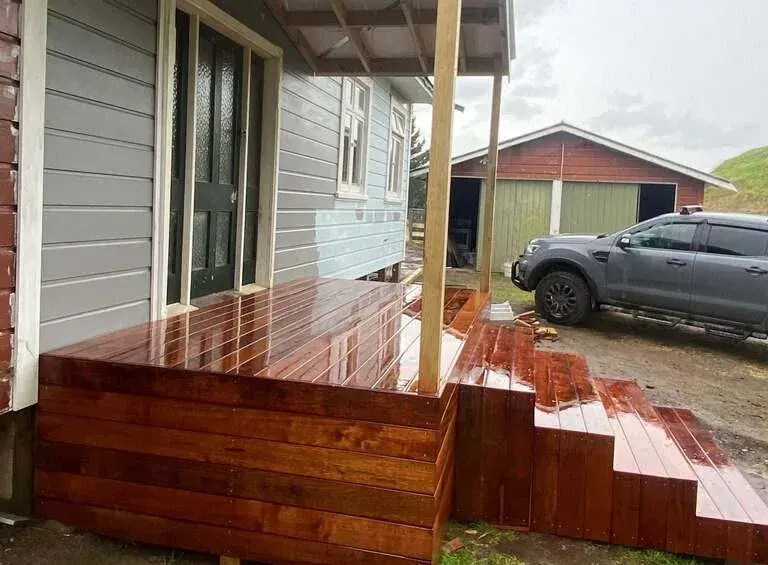
There is no single best decking
The best decking timber depends on your budget, how the deck will be used, how much sun it gets and how much maintenance you are happy to do. Every timber below can make a good deck if the frame underneath is built properly. Here is how they compare, from people who build with them.
| Timber | Colour | Hardness | Upkeep |
|---|---|---|---|
| H3.2 treated pine | Pale, takes any stain | Soft | Stain every 1–2 years |
| Kwila | Deep red-brown | Very hard | Oil yearly, or let it grey |
| Vitex | Golden to mid brown | Hard | Oil yearly, or let it grey |
| Garapa | Pale honey | Very hard | Oil yearly, or let it grey |
| Purpleheart | Purple, fading to brown | Extremely hard | Oil yearly |
| Accoya | Pale, takes coatings well | Medium | Very stable, coat as desired |
| Abodo (thermally modified) | Warm brown | Medium | Oil to hold colour |
| Macrocarpa | Golden, NZ-grown | Soft–medium | Oil regularly; best kept above ground |
For what moves the price of an installed deck, see the deck cost guide.
Kwila vs pine decking
This is the comparison most Palmerston North homeowners make. Pine is the affordable choice: it is NZ-grown, H3.2 treated, and takes stain in any colour. It is softer, so it marks and splinters more as it ages, and it needs staining every year or two to look its best. Kwila costs more but is much harder, naturally durable and has a rich colour that pine cannot match. It bleeds tannin when new and wants oiling once a year to hold its colour.
If budget is the main driver, pine on a well-built frame is a good deck. If you want a deck that looks premium and wears hard, kwila is worth the extra. More on our pine decks and timber decking pages.
Vitex vs kwila, and garapa vs kwila
Vitex vs kwila
Vitex is a tropical hardwood that is often a little cheaper than kwila and lighter in colour, golden to mid brown rather than red-brown. It is generally regarded as bleeding less tannin than kwila, which helps if your deck sits above pale paving. Kwila is the harder and better-known of the two.
Garapa vs kwila
Garapa is a pale, honey-coloured hardwood. It is very hard and fine-grained, and suits modern homes where kwila's red tone would feel heavy. Like other hardwoods it greys off if left unoiled.
Kwila decking price in NZ
Kwila board prices move with supply, and the installed price depends on height and design. Ask about certified or verified-legal timber if sourcing matters to you.
Purpleheart, Accoya, Abodo and macrocarpa decking
Purpleheart (purple heart) decking
An extremely hard, dense tropical hardwood with a striking purple colour that mellows to brown with sun. Very durable, but hard to work and usually expensive.
Accoya decking
Radiata pine that has been chemically modified (acetylated) to make it very stable and durable. It moves less than most timbers and takes coatings well, but it is at the premium end on price.
Abodo decking
A NZ-made, thermally modified timber. Heat treatment makes it more stable and durable than untreated wood without chemical preservatives. It has a warm brown colour that greys off without oil.
Macrocarpa decking
NZ-grown macrocarpa has a lovely golden colour and smell, but it is only moderately durable. It is better suited to decks well clear of the ground with good airflow, and needs regular oiling.
Not set on timber? Compare it with composite in our composite vs timber decking guide. We bring real board samples to every on-site quote.