Treated Pine Decking in Palmerston North

  • The most affordable way to get a big deck
  • H3.2 boards and framing, H4 piles in the ground
  • Stain to any colour you like
  • Free on-site measure, written price within 48 hours

Get your free on-site quote

By clicking "Get Free Quote", you agree that your information will be shared with Rowdy Builders, to contact you regarding your quote request. See our Privacy Policy and Terms of Use.
We've got your message. We'll be in touch within the next few hours.
Oops! Something went wrong while submitting the form.
pine decking nz

Pine decking: a solid deck without the premium price

Pressure treated pine decking, usually H3.2 radiata pine, is the most common decking timber in New Zealand for good reason. It is locally grown, readily available and the most affordable way to build a deck of any real size. Built properly and looked after, a pine deck gives years of good service.

Most of the decks we build around Palmerston North start as a conversation about pine. For a family home in Awapuni or Highbury where the budget needs to stretch to a big outdoor area, it is often the right answer. Where it goes wrong is when corners get cut on the timber grade, the fixings or the frame. That is the part we focus on.

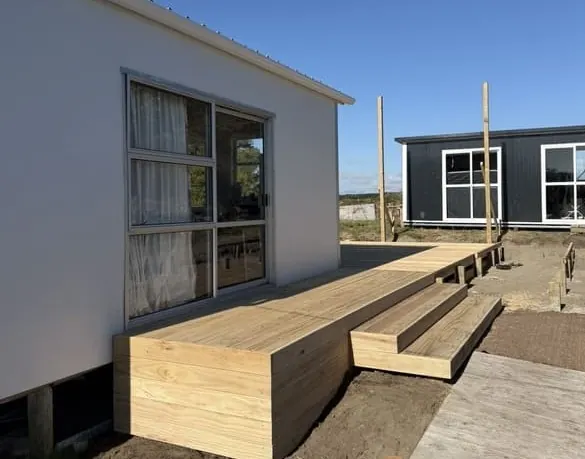
New timber deck with steps built beside a home in Palmerston North
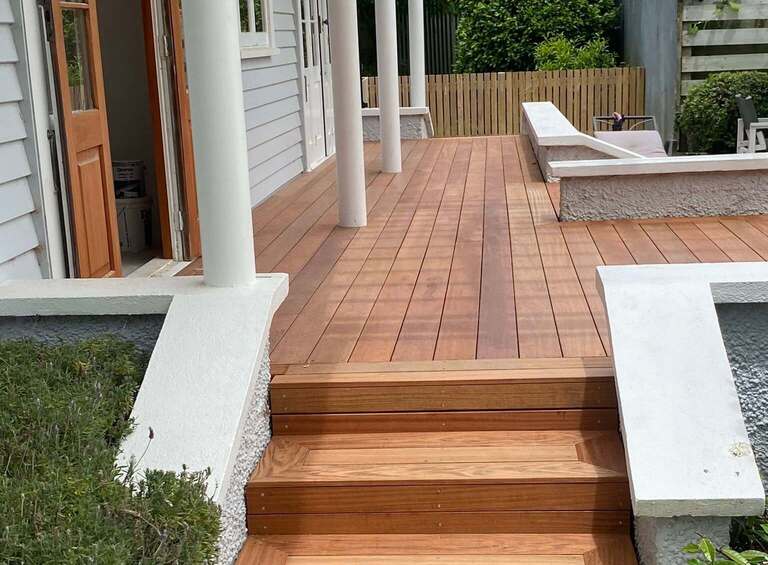
Timber deck and steps with white posts, Palmerston North
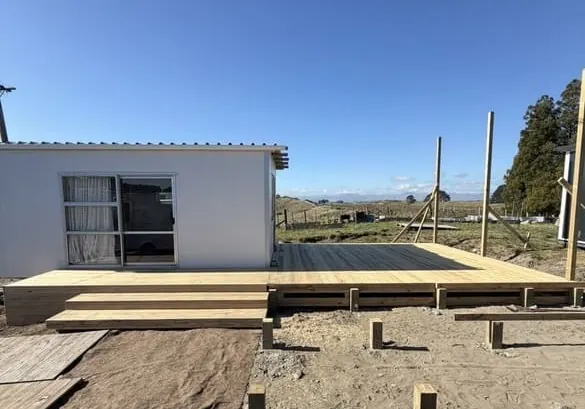
New timber deck under construction beside a sleepout, Palmerston North
doing it properly

What makes a pine deck last

The right treatment for where the timber sits

Treatment levels matter. Deck boards and framing above ground need H3.2. Piles that go into the ground need H4. Using a lower grade than the job needs saves a few dollars on day one and costs a whole deck ten years later. Every piece of timber we use is treated to the level its position calls for.

Sealed cut ends

The treatment does not go all the way through every board. When we cut timber on site, the freshly exposed end gets a preservative so water does not soak into the untreated core. It takes a few extra minutes per board and it is one of the most commonly skipped steps.

Fixings that will not rust out

Treated pine is corrosive to plain steel. We use hot-dip galvanised or stainless fixings so nothing rusts through or stains the boards.

Joists at the right centres

Pine decking needs joists close enough together that the deck feels solid underfoot. We frame to the span the board calls for, not the widest spacing we could get away with.

Smooth or grooved boards

Pine decking comes smooth or with a grooved, or reeded, face. Grooved boards can give more grip, but they also hold dirt and grow moss in shady spots. Smooth boards are easier to clean and stain. We will talk you through it based on where your deck sits.


Get Free Quote →
looking after it

Staining and maintenance

Pine takes stain well, so you can match your deck to the house or go darker to hide wear. Plan on:

  • Leaving new treated pine to dry and weather for a few weeks to a few months before the first coat of stain or oil. We will tell you how long for your boards
  • Washing and recoating every year or two to keep it looking sharp
  • Keeping leaf litter and moss off, especially on the shady side of the house

Want less maintenance? Composite decks need almost none. Want a richer timber? Look at kwila and hardwood.

Get Free Quote →
pricing

What a pine deck costs in Palmerston North

Pine is the most affordable of the three decking options. As a rough guide:

DeckingIndicative installed priceExample: 20m² ground-level deck
H3.2 treated pine$300 – $550 per m²$6,000 – $11,000
Kwila & hardwood$450 – $850 per m²$9,000 – $17,000
Composite$550 – $1,000 per m²$11,000 – $20,000

These are indicative ranges only, not a quote. They are a rough guide based on typical New Zealand deck pricing, set deliberately wide. Height off the ground, ground conditions, access, board and fixing choice, stairs, balustrade, removal of an old deck and whether consent is needed all move the final number, sometimes a long way. The only price that counts is the fixed written price we give you after measuring up on site. Prices include GST.

See the full breakdown, including raised decks, stairs and balustrades, in our deck cost guide.

Get Free Quote →
FAQs

Treated pine decks: questions we get asked

How long does a treated pine deck last?

The H4 piles and H3.2 framing should last for decades. Pine boards last well if they are looked after: stained or oiled every year or two and kept clear of leaf litter. Neglected boards wear and split sooner.

What does H3.2 and H4 mean?

They are New Zealand timber treatment levels. H3.2 is for timber outside and above ground, like deck boards and framing. H4 is for timber in the ground, like piles. The higher the number, the harsher the conditions the timber is treated for.

When can I stain my new pine deck?

New treated pine needs time to dry out before it will take a stain properly. That can be a few weeks to a few months depending on the boards and the weather. We will tell you what to look for.

Is pine strong enough for a big deck?

Yes. The strength comes from the frame, the pile spacing and the joist centres, and they are designed for the size and height of the deck. Pine decks of any size are built to the same standard.

Grooved or smooth pine boards?

Grooved boards can give a bit more grip, but they hold dirt and moss in shady spots. Smooth boards are easier to keep clean and stain more evenly. Most people end up choosing smooth.

Can I upgrade to composite or kwila later?

Usually not without rebuilding, because composite needs closer joist spacing. If you are leaning towards a different board in a few years, it is worth talking about it before we frame the deck.

Get Free Quote →
keep reading

Other decks we build

Let's build a deck you're proud of

Free on-site quote. Fixed price in writing. Decks, fences and pergolas.

Get Free Quote →
Get Free Quote →
Tap To Call