


Composite Decking in Palmerston North

  • No oiling, staining or splinters, ever
  • Built on H4 piles and H3.2 framing at composite joist spacing
  • Board samples brought to your place
  • Free on-site measure, written price within 48 hours

Get your free on-site quote

By clicking "Get Free Quote", you agree that your information will be shared with Rowdy Builders, to contact you regarding your quote request. See our Privacy Policy and Terms of Use.
We've got your message. We'll be in touch within the next few hours.
Oops! Something went wrong while submitting the form.
composite decking

A deck you use, not one you maintain

Composite decking is made from a mix of wood fibre and plastic, usually with a hard outer cap that resists staining and fading. For a lot of Palmerston North homeowners it ends the yearly cycle of washing, sanding and oiling. You hose it down a couple of times a year and that is about it.

It is the most expensive of the three decking options up front, and it is not the right call for everyone. But if you are planning to stay in the house, have kids or dogs who are hard on a deck, or you are just sick of oiling, it is usually the one people are happiest with five years later.

We build composite decks right across Palmerston North and Feilding, from small landings off a ranch slider in Kelvin Grove to full wraparound decks on newer homes out in Aokautere. The board on top is different. The structure underneath is built the same way we build every deck.
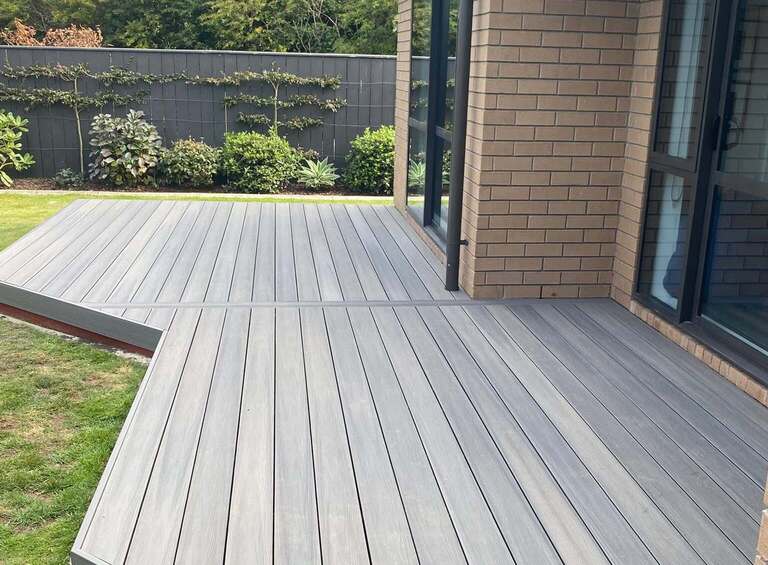
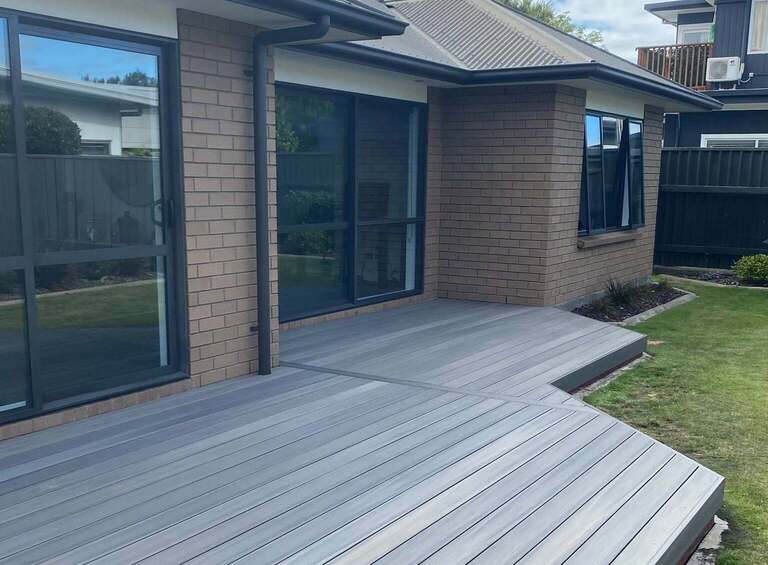
Grey composite deck built against a brick home, Palmerston North
Grey composite decking installed beside a brick home, Palmerston North
what's different

How we build a composite deck

Closer joist spacing

Composite boards are more flexible than hardwood, so most systems call for joists at closer centres than a pine or kwila deck. Some manufacturers specify tighter spacing again when boards run on a diagonal. Skimp on this and the deck feels bouncy underfoot and the boards can sag between joists. We frame to the board manufacturer's spacing, not the minimum we could get away with.

Expansion gaps that actually allow for summer

Composite grows and shrinks with temperature far more than timber does. On a north-facing deck in a Manawatū summer the boards get hot. End gaps and side gaps are set to the manufacturer's spec for the temperature on the day we lay them, which is the difference between a tidy deck and one with buckled joins in February.

Hidden fixings and a clean edge

Most composite systems use hidden clips between the boards, so there are no screw heads on the surface. Exposed board ends and the deck edge get fascia boards to match, so you are not looking at the cut core of the board or the framing underneath.

The substructure is still timber

Under almost every composite deck in New Zealand is a treated timber frame: H4 piles in the ground and H3.2 bearers and joists. It is the part that decides whether the deck is still solid in fifteen years, and it is the part that never gets seen once the boards are down. We use joist protection tape on top of the framing where the system calls for it, so water does not sit on the timber under the boards.

Ventilation underneath

Composite decks on low-level, flat sections need airflow underneath. A deck boxed in tight to the ground with no gaps traps moisture, which is hard on the framing. We leave the ventilation gaps the system specifies, even on low decks off a back door.

Get Free Quote →
pros and cons

Is composite right for your place?

Why people choose it

  • Close to zero maintenance: no oiling, sanding or staining
  • Colour stays consistent for years, with no greying off
  • No splinters, which matters for kids and bare feet
  • Does not bleed tannin onto paving or concrete the way kwila can
  • Long manufacturer warranties on the boards themselves

What to be aware of

  • Highest up-front cost of the three options
  • Darker colours get hot in full summer sun. If your deck faces north with no shade, go lighter or plan a pergola
  • It is not timber. Up close it looks like a quality manufactured product, not a natural board
  • Cheap composites can scratch and fade. We would rather talk you into a better board than build with one we would not stand behind

Not sure? We bring composite, kwila and pine samples to the on-site quote so you can see and feel all three on your own deck site. Read more about kwila and hardwood decks and treated pine decks.

Get Free Quote →
composite decking nz

Composite decking installation: brands and boards

Composite decking in NZ comes from a handful of established suppliers. Names you will see include Ekodeck, Modwood decking and Futurewood decking, along with others sold through local timber merchants. Most are capped composite boards, sometimes called WPC decking (wood-plastic composite), with a protective outer shell over a core of wood fibre and recycled plastic.

The differences between brands come down to the cap, the colour range, board profile, the hidden fixing system and the warranty. When we quote, we talk through which boards suit your deck, your budget and how much sun it gets, and we install to that brand's own instructions: joist spacing, gaps and fixings. If you already have a brand in mind, tell us and we will price it.

Is composite really low maintenance decking?

Close to it. Composite never needs oiling, sanding or staining. It does still need a clean a couple of times a year to stop dirt and mildew building up, especially in shady spots, but that is a hose and a soft brush, not a weekend of work. Compare the two properly in our composite vs timber decking guide.

Working with a composite deck builder

Composite decking installation is less forgiving than timber. The boards move more with temperature, the joists need to be closer together, and the fixing systems are specific to each brand. A composite deck builder who has not done it before can leave gaps too tight, joists too far apart, or cut ends exposed. We frame to the board manufacturer's spec and finish the edges with matching fascia boards.

pricing

What a composite deck costs in Palmerston North

Composite is the dearest of the three decking options to install, mostly because of the board cost and the closer joist spacing. As a rough guide:

DeckingIndicative installed priceExample: 20m² ground-level deck
H3.2 treated pine$300 – $550 per m²$6,000 – $11,000
Kwila & hardwood$450 – $850 per m²$9,000 – $17,000
Composite$550 – $1,000 per m²$11,000 – $20,000

These are indicative ranges only, not a quote. They are a rough guide based on typical New Zealand deck pricing, set deliberately wide. Height off the ground, ground conditions, access, board and fixing choice, stairs, balustrade, removal of an old deck and whether consent is needed all move the final number, sometimes a long way. The only price that counts is the fixed written price we give you after measuring up on site. Prices include GST.

Raised decks, stairs, balustrades and removal of an old deck all add to the figure. The full breakdown is in our deck cost guide for Palmerston North.

Get Free Quote →
FAQs

Composite decks: questions we get asked

Which composite decking brands do you install?

We will talk through the composite decking brands available in NZ, like Ekodeck, Modwood and Futurewood, and recommend boards to suit your deck and budget. If you have a brand in mind already, we can price it.

How long does a composite deck last?

The boards from reputable manufacturers carry long warranties, often 20 to 25 years, and the H4 and H3.2 timber frame underneath should last decades if it is built and ventilated properly.

Does composite decking get hot?

Darker colours can get hot in full summer sun, the same as a dark car bonnet. Lighter greys and browns stay noticeably cooler. If your deck faces north with no shade, we will point you at a lighter board or talk through shade options.

Is composite decking slippery when wet?

Capped composite boards have a textured surface and are generally no more slippery than oiled timber. Like any deck, keeping it free of moss and leaf build-up in the shady corners makes the biggest difference.

Can you put composite boards on my existing deck frame?

Sometimes, but usually not. Composite needs closer joist spacing than most existing pine or kwila decks were built with, and there is no point putting 25-year boards on a frame with ten years left in it. We will check the frame when we measure up and tell you straight.

How do you clean a composite deck?

Warm soapy water and a soft brush or a hose a couple of times a year. Avoid harsh chemicals and high-pressure water up close. There is no oiling or staining.

Do you do composite pool decks?

Yes. Composite works well around pools because it does not splinter and handles water well. See our pool decks page for how we keep the pool barrier compliant.

Get Free Quote →
keep reading

Other decks we build

Let's build a deck you're proud of

Free on-site quote. Fixed price in writing. Decks, fences and pergolas.

Get Free Quote →
Get Free Quote →
Tap To Call