

Building a Deck in NZ: How a Deck Is Built

  • Deck piles, footings and screw piles
  • Bearer, post and joist spacing explained
  • What a good deck builder does that a cheap one skips
  • What to check in a deck quote

Get your free on-site quote

By clicking "Get Free Quote", you agree that your information will be shared with Rowdy Builders, to contact you regarding your quote request. See our Privacy Policy and Terms of Use.
We've got your message. We'll be in touch within the next few hours.
Oops! Something went wrong while submitting the form.
building a deck nz

Building a deck in NZ, step by step

Wondering how to build a deck properly? Most of what decides whether a deck lasts is the part nobody sees once the boards are down. This guide explains how a deck is built in New Zealand, so you know what you are paying for, what to ask a deck builder, and what to check in a quote. If you are planning to build it yourself, it covers the decisions you need to get right.

In NZ, most decks are designed to NZS 3604, the standard for light timber framing, which sets pile, bearer and joist sizes and spacings for a given span and height.
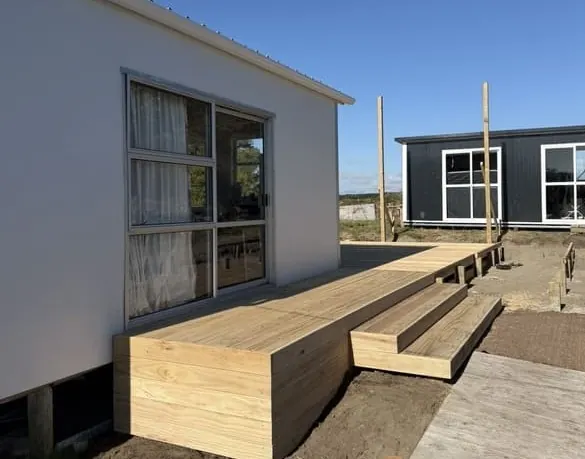
New timber deck and steps under construction, Palmerston North
Joists and framing before boards go on
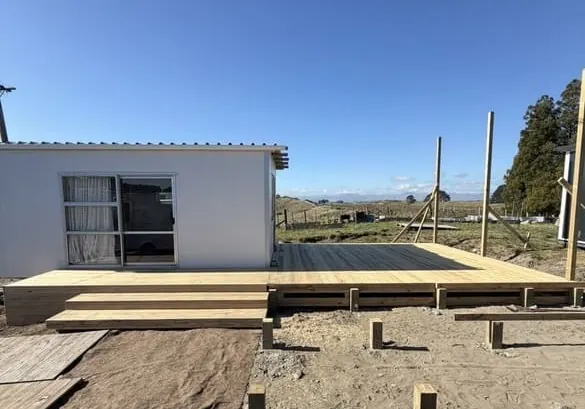
New timber deck under construction beside a sleepout, Palmerston North
Deck framing beside a sleepout
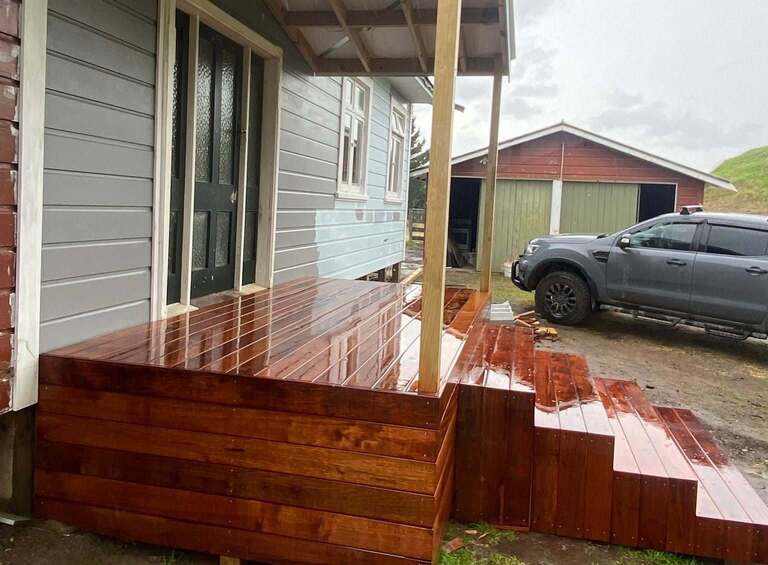
New timber deck with steps built beside a home in Palmerston North
Finished deck with steps
step 1 and 2

Set-out and deck piles

1. Levels and set-out

The finished height is set by the door threshold, allowing for the step down and clearance to the cladding. From there the builder works out the frame depth, the pile heights and how many steps are needed. The deck's outline is set out with string lines so it is square.

2. Deck piles and footings

Piles carry the deck's weight into the ground. In NZ they are usually H4 or H5 treated timber posts set in concrete footings, dug down to firm ground. Deck footings in NZ need to be deep enough for the soil and the deck's height, and taller decks need braced piles to stop the deck racking sideways.

Screw piles for decks

Screw piles (helical steel piles) are screwed into the ground with a machine instead of being dug and concreted. They are fast, need less digging, and can suit soft ground or sites where excavation is hard. They must be a proprietary product installed to the manufacturer's specification.

step 3 and 4

Deck framing: bearers and joists

3. Bearers, bearer spacing and deck post spacing

Bearers are the heavy beams that sit on the piles. Bearer spacing on a deck and deck post spacing go together: bigger bearers can span further between piles. NZS 3604 span tables set the combinations. Piles commonly end up somewhere between about 1.2 and 1.8 metres apart, depending on bearer size and load.

4. Joists and deck joist spacing

Joists run across the bearers and carry the boards. Deck joist spacing depends on the board: around 450mm centres is common for 32mm pine boards, hardwood boards may need 450mm or closer, and composite often needs 400mm or less, set by the manufacturer. Too wide and the deck feels bouncy and boards sag.

Fixing to the house

If the deck attaches to the house, it is fixed to the house framing through a stringer, with spacers and flashings so water cannot track into the wall. A badly fixed stringer is one of the most common causes of rot in the house itself.

step 5 and 6

Boards, finishing and timing

5. Decking boards

Boards are laid with consistent gaps for drainage and movement, fixed with stainless or hot-dip galvanised screws or hidden clips, and cut ends are sealed on treated pine. Boards are kept straight across the run.

6. Stairs, balustrades and finishing

Stairs with even rises, a balustrade wherever the fall is one metre or more, and fascia boards to finish the edges. Then a tidy-up. See deck stairs and balustrades.

How long does it take to build a deck?

Most residential decks take one to two weeks on site once the build starts. Day one or two: set-out, piles. Days two to four: bearers and joists. Days four to five: boards. Then stairs, balustrade and finishing. Raised decks and consented work take longer.

what to check

What to check in a deck quote

  • Pile treatment (H4 or H5), and how deep and how far apart they are
  • Bearer and joist sizes, and joist spacing that suits the boards you chose
  • Timber treatment levels: H3.2 for framing and boards above ground
  • Fixing type: stainless or hot-dip galvanised, or the composite system's clips
  • How it fixes to the house, including flashings
  • Whether a balustrade or building consent is needed, and who handles it
  • Whether removing the old deck is included

Our quotes list the timber, sizes and what is included in writing. Read when a deck needs consent or check what a deck costs.

Get Free Quote →
FAQs

How a deck is built: common questions

How deep do deck piles need to be in NZ?

Deep enough to reach firm ground and suit the deck's height and load, as set out in NZS 3604. Taller decks need deeper, braced piles.

What joist spacing should a deck have?

Commonly around 450mm for 32mm pine boards, and often 400mm or less for composite, set by the board manufacturer.

Are screw piles good for decks?

They can be, especially on soft ground or where digging is hard. They must be a proprietary system installed to the manufacturer's spec.

How long does it take to build a deck?

Most residential decks are one to two weeks on site. Raised decks and consented decks take longer.

Can I build a deck myself in NZ?

Many people do. Exempt decks still have to meet the Building Code, so follow NZS 3604 and get the frame, fixings and any balustrade right.

Get Free Quote →
more deck guides

More deck guides

Ready to talk about your deck?

Free on-site quote. Fixed written price within 48 hours.

Get Free Quote →
Get Free Quote →
Tap To Call